As organizations scale, execution slows due to structural inefficiencies across workflows, systems, and decision pathways. This breakdown shows how friction constrains performance—and how structured environments restore speed and control.
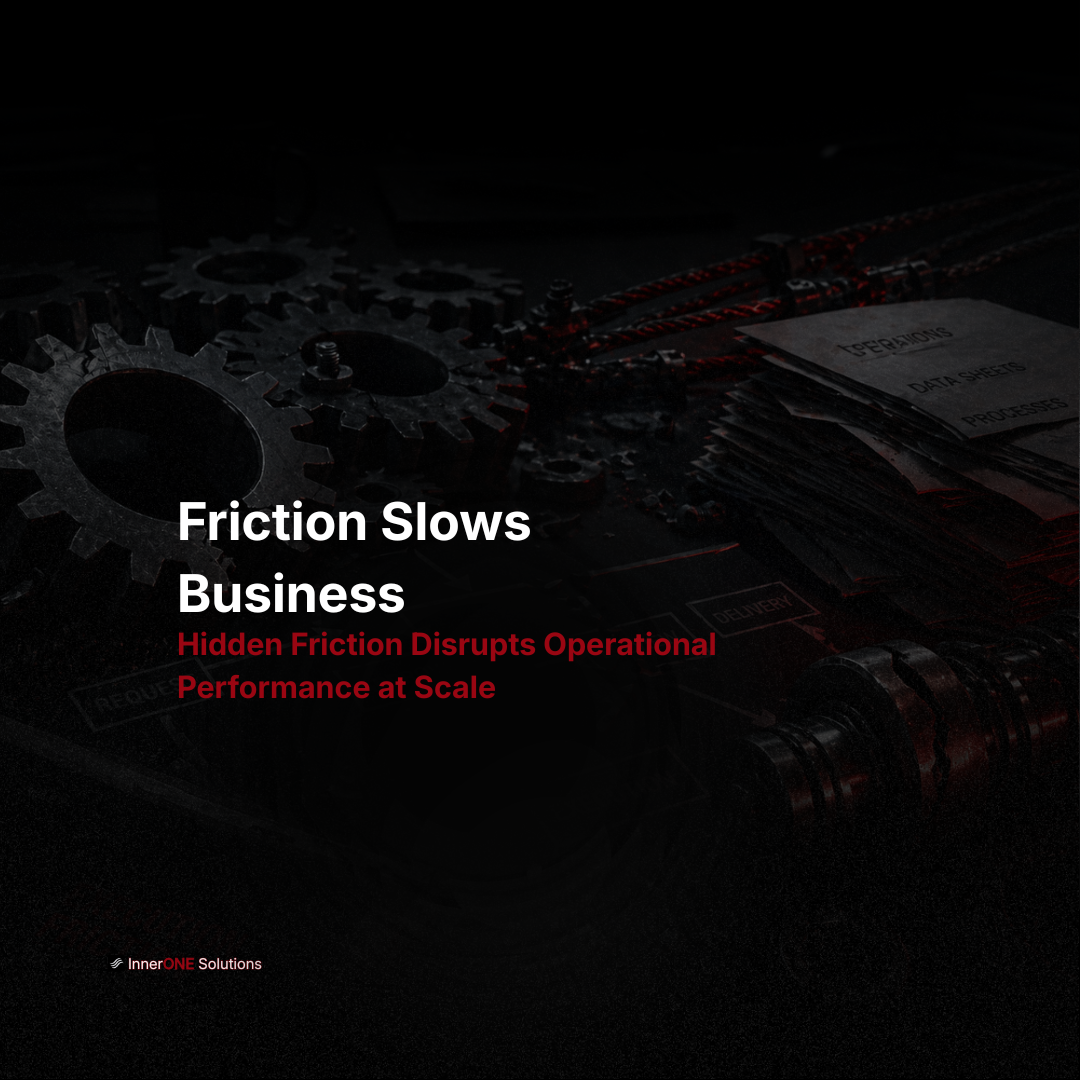
As organizations grow, leaders expect output to scale proportionally. More people, more tools, and more activity should produce faster execution and stronger performance.
In practice, the opposite often occurs.
Execution slows. Coordination expands. Decisions require more inputs, more clarification, and more time. Work continues to move, but not with the speed, consistency, or predictability expected at scale.
This slowdown is rarely attributed to structure.Instead, it is misinterpreted as a need for stronger discipline, clearer communication, or tighter accountability.
The constraint is execution friction.
Execution friction is not a single breakdown. It is the accumulation of micro‑inefficiencies embedded within workflows, systems, and decision pathways. Individually, these inefficiencies appear manageable. Collectively, they become the dominant constraint on performance.
Execution friction develops at the intersections of work — the points where tasks, teams, and systems meet.
As workflows expand across functions, handoffs increase. Each handoff introduces variability. Without defined transitions, work is reinterpreted, delayed, or duplicated.
Information fragments across conversations, documents, and disconnected systems. Teams operate with partial visibility, forcing decisions to be made without complete context. This leads to misalignment, rework, and avoidable delays.
Ownership becomes diluted.In smaller environments, ownership is implied. At scale, implied ownership becomes unclear ownership. When responsibility is diffused, accountability weakens and predictability disappears.
Systems, when implemented independently, amplify friction.Tools may function effectively in isolation, but without integration, they create parallel workflows that require manual coordination to sustain. Data is duplicated. Work is tracked in multiple locations. Visibility decreases.
The result is an environment where execution continues — but with increasing resistance.
Execution friction is not a behavioral issue.It is a structural condition.
In a friction‑heavy environment, progress depends on intervention. Teams must continuously clarify, follow up, and realign to maintain movement. Execution becomes effort‑intensive rather than system‑supported.
A structured environment removes this dependency.
Workflows define how tasks move.Ownership clarifies responsibility at each stage.Systems align information and eliminate duplication.Visibility enables performance to be measured without manual tracking.
When these elements are in place, friction is reduced not by increasing effort, but by removing the conditions that create resistance.
Reducing execution friction requires alignment across three core components:
Strategy establishes priorities.Systems translate those priorities into workflows, tools, and data structures.Execution discipline ensures those workflows are followed consistently.
When aligned, work moves with minimal resistance.Dependencies are managed within the system.Decisions are supported by accessible, consistent data.
When alignment is absent, friction compounds.Work requires constant intervention.Progress slows, even as effort increases.
Execution friction does not stop work.It constrains performance capacity.
Timelines extend beyond expectation.Decisions are delayed due to incomplete information.Resources are consumed by coordination rather than output.
Over time, these effects reduce the organization’s ability to scale effectively.
Organizations that remove friction operate differently.Execution accelerates without increased effort.Teams function with clarity.Decisions are made with confidence.
Performance becomes efficient, not just active.
InnerONE Solutions treats execution friction as a structural problem, not a behavioral one.
We identify where workflows break, where systems misalign, and where ownership is unclear. From there, we design operating environments that eliminate unnecessary resistance.
The objective is not to push teams harder.The objective is to create an environment where execution flows.
By engineering the operating system — workflows, ownership, systems, and visibility — friction is reduced at its source and performance becomes controlled, predictable, and scalable.
Execution friction is often normalized because it develops gradually. Symptoms are addressed individually, while the underlying structure remains unchanged.
The Diagnostic Snapshot isolates where friction exists and how it impacts performance. It establishes a clear path for removing structural barriers to execution.
When friction is removed, execution accelerates.And when execution accelerates, growth becomes sustainable.
Blog
InnerONE Intelligence
May 4, 2026
.svg)