Rising costs, wage limitations, and benefit structures are creating a three-sided constraint impacting workforce participation and small business stability.
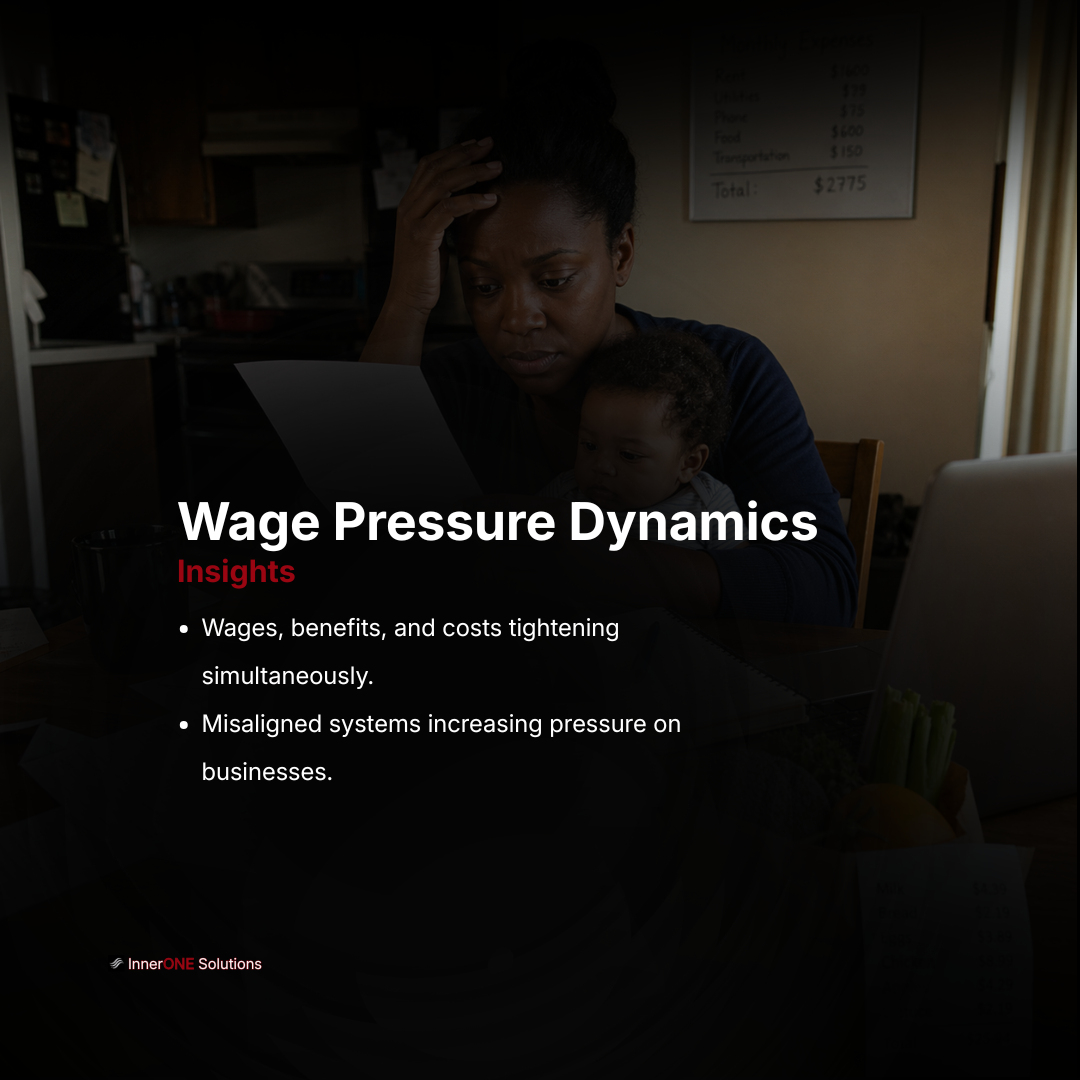
Current economic conditions are creating a tightening cycle between wages, public assistance programs, and small business operating capacity. As living costs rise, wage growth in many sectors has not kept pace—leaving some workers unable to meet basic financial needs even when employed.
At the same time, income‑support programs such as the Supplemental Nutrition Assistance Program (SNAP) influence how individuals evaluate employment decisions, particularly when incremental earnings reduce benefit eligibility.
This dynamic creates a converging structural constraint:
Together, these forces are reshaping workforce availability and small business stability.
The U.S. Bureau of Labor Statistics reports that while wages have increased, they have not consistently kept pace with rising housing, food, and essential living costs.Source: https://www.bls.gov
USDA data shows SNAP continues to support tens of millions of households, reflecting persistent income pressure at the lower end of the wage spectrum.Source: https://www.fns.usda.gov/snap
Urban Institute research highlights that benefit phase‑outs can create effective marginal tax rates, where increased earnings reduce assistance and limit net financial gain.Source: https://www.urban.org
These factors collectively shape how workers and businesses make decisions in a constrained economic environment.
In many small and service‑based sectors:
This creates a visible gap:Jobs exist, but not all provide sufficient economic lift.
Difficulty attracting and retaining employees at wage levels that lag behind cost‑of‑living realities.
Expectations for higher wages rise faster than revenue growth, compressing margins.
Reduced staffing affects service delivery, consistency, and customer experience.
Some businesses reduce hours, scale back operations, or close entirely when unable to adjust.
SNAP is designed to stabilize households, but its structure interacts directly with wage conditions:
This is not a flaw in intent—it is a structural interaction between systems.
When these forces are misaligned, friction increases across the system.
Assess wage competitiveness relative to local cost‑of‑living conditions.
Explore leaner staffing models, automation, or redesigned workflows.
Ensure pricing and service structures can support sustainable wage growth.
Recognize that financial decisions are shaped by both income and benefit interactions, not wages alone.
Workforce participation is shaped by total financial outcome, not just hourly pay.Businesses that understand the interplay between wages, living costs, and benefit structures are better positioned to attract, retain, and support their workforce while maintaining operational stability.
As economic pressure intensifies, alignment between wages, cost of living, and support structures becomes increasingly critical. Sustainable business operations require systems that work for both the organization and the people within it.
Insight
InnerONE Intelligence
May 14, 2026
.svg)